How GanttGrind Calculates Your Exam Readiness Score
You've Done Hundreds of Questions — But Are You Actually Ready?
High accuracy feels good. But accuracy alone doesn't tell you what matters: will you hold up under real exam conditions?
You can inflate a raw accuracy number by drilling topics you already know. Staying comfortable won't expose you to the questions that will actually cost you on exam day.
That's what the GanttGrind Readiness Score is built to address. It's a single number — scored 0 to 100 — that tries to answer the harder question: how prepared are you, really?
Five Stages, One Honest Assessment
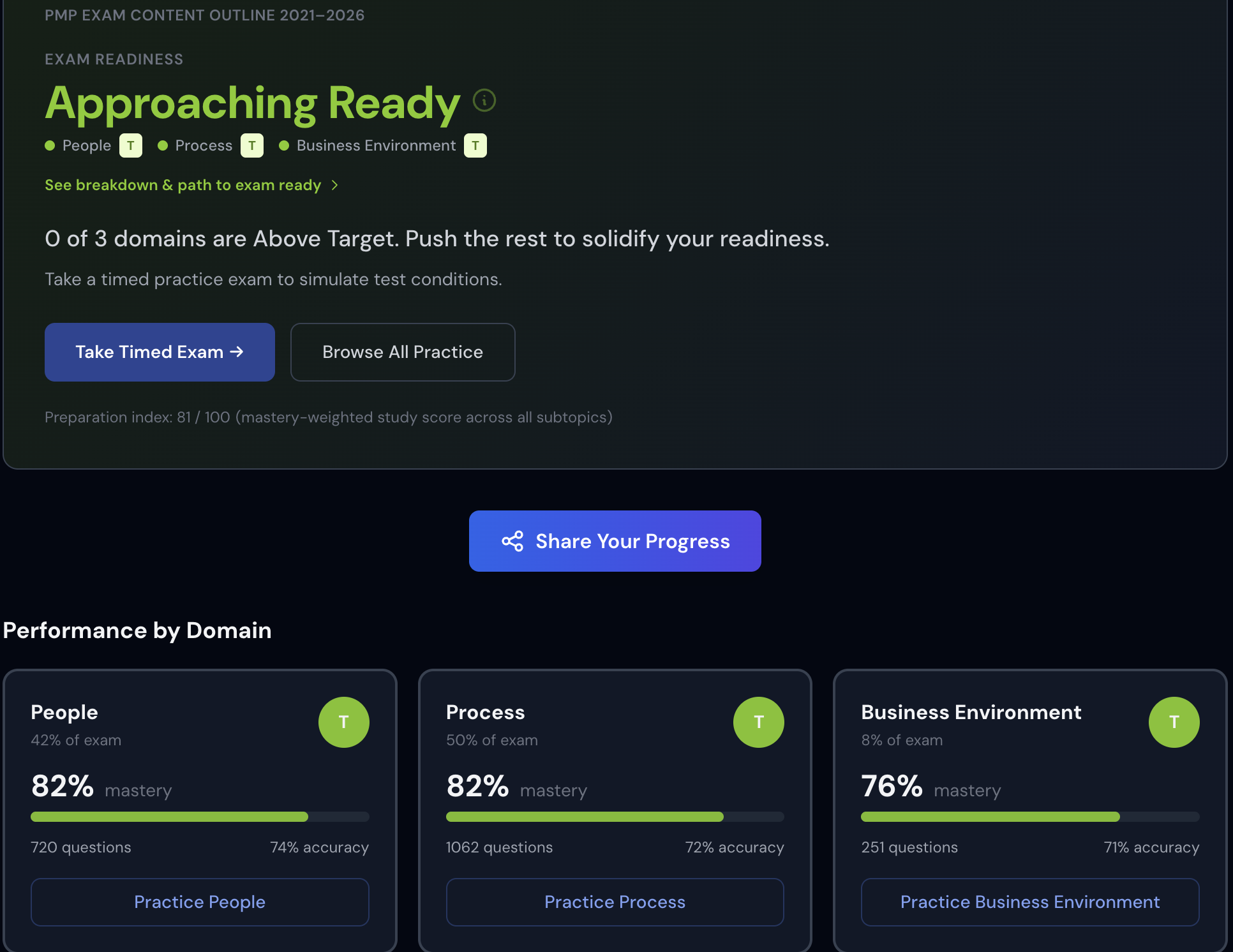
Readiness is reported as one of five stages:
| Stage | What it means |
|---|---|
| Building Foundation | Early days — coverage and mastery are both low |
| Needs Work | Material gaps or persistent weak areas to address |
| Developing | Progress is visible, but not yet at passing threshold |
| Approaching Ready | All domains at Target or above — polish and validate |
| Exam Ready | Full domain validation complete, above-target across the board |
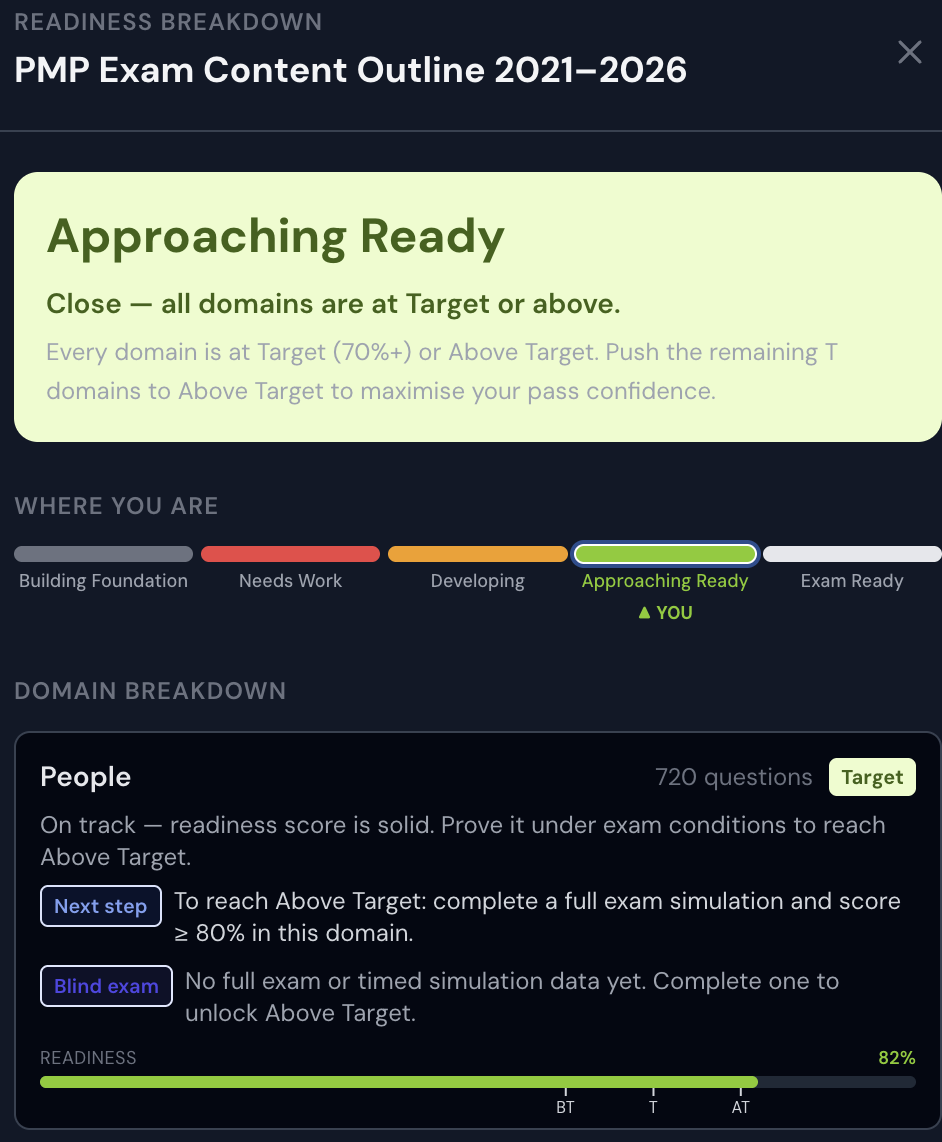
Approaching Ready means every domain has cleared the Target threshold (70%+), but hasn't yet been validated under timed exam conditions. That gap — between solid guided practice and confirmed performance under pressure — is where most candidates are when they think they're done studying.
Performance by Domain: Target, Above Target, Below Target
Every domain gets its own readiness signal with three possible ratings:
- Below Target (BT) — performance below the passing standard for this domain
- Target (T) — at the passing threshold; solid, but without margin
- Above Target (AT) — consistently above the expected passing level
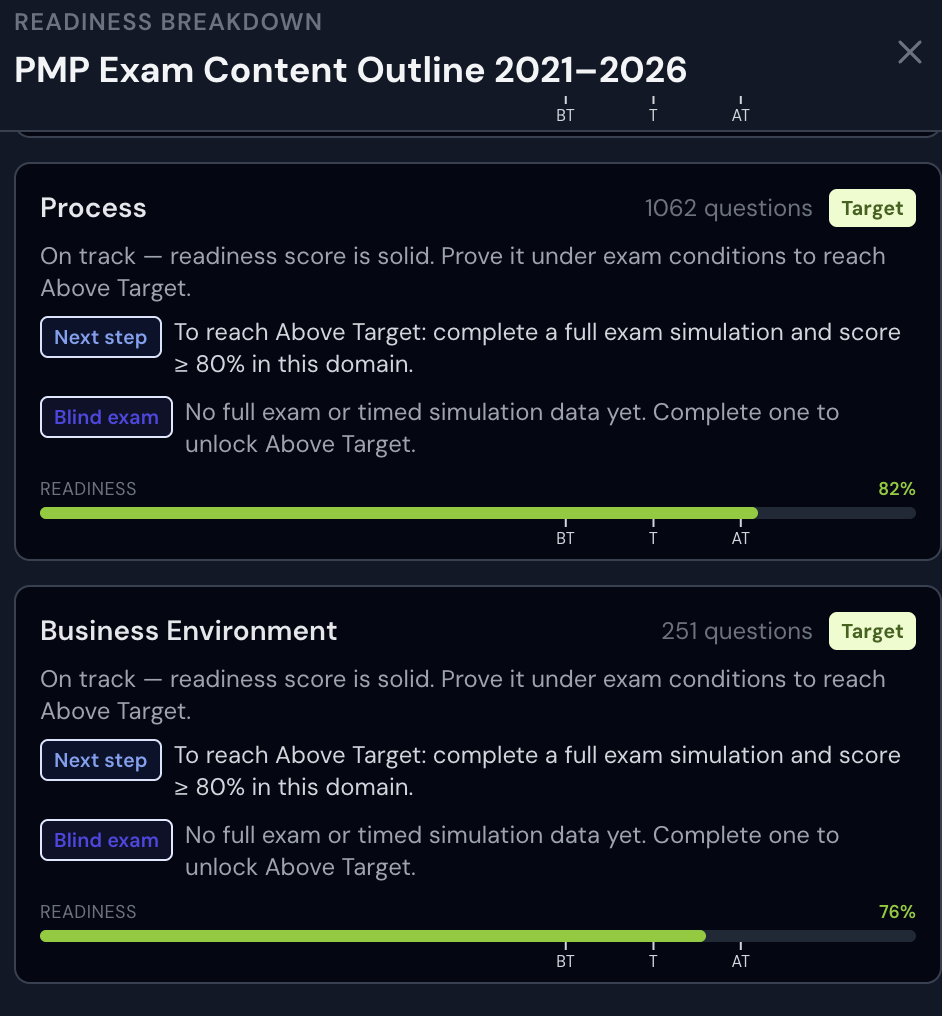
The example above shows all three domains at Target — 82%, 82%, and 76% readiness respectively. The progress bar for each domain shows where the BT, T, and AT thresholds sit, so you can see exactly how much runway you have before clearing the next level.
How the Score Is Calculated
The preparation index (scored 0–100) is built from four independent signals. Using multiple signals makes the score much harder to inflate than raw accuracy alone.
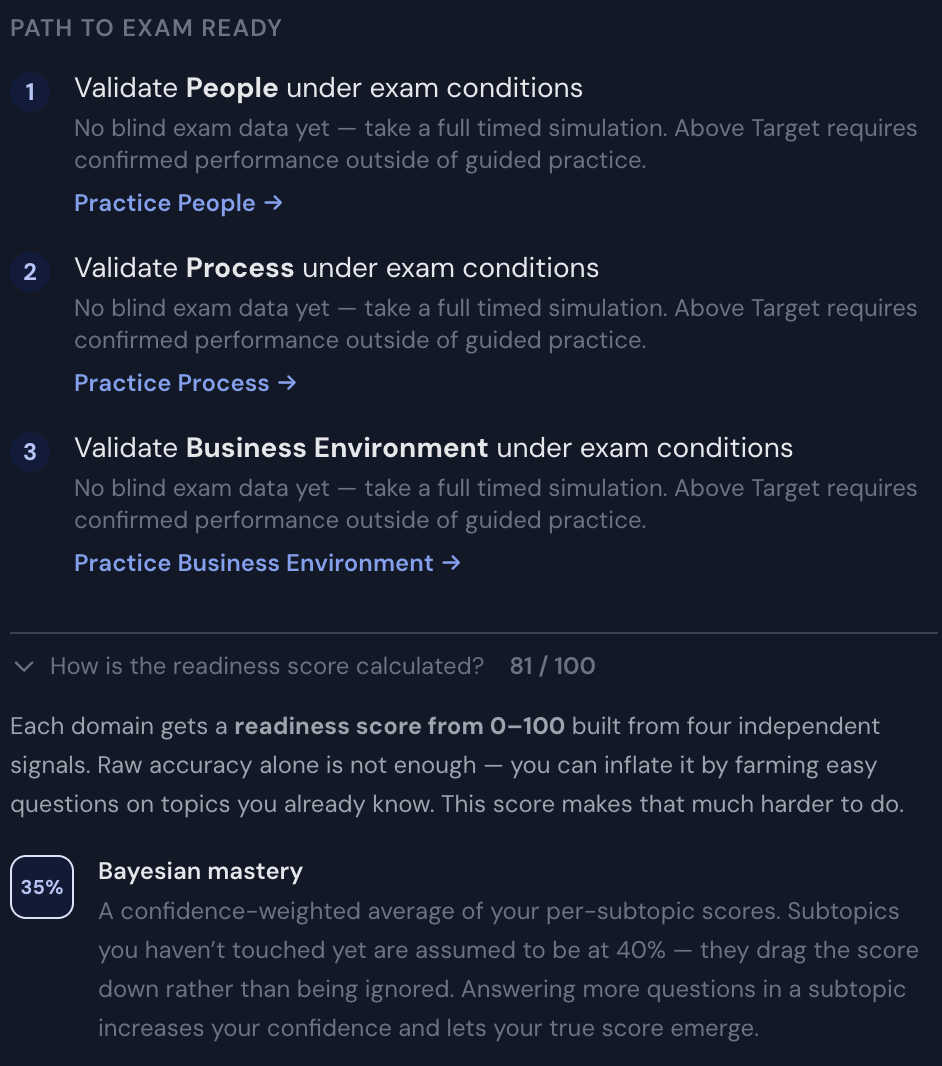
Bayesian Mastery — 35%
A confidence-weighted average of your per-subtopic scores.
The key mechanic: subtopics you haven't practiced yet are assumed to start at 40% — not 0%, and not ignored. They drag your score down rather than being hidden from view. As you answer more questions in a subtopic, confidence in your true score increases and the estimate sharpens.
This means you can't get a high readiness score by mastering half the syllabus deeply while leaving the other half untouched. Gaps cost you.
Topic Coverage — 25%
How broadly you've practiced across the domain's full syllabus.
Depth and breadth are different things. Answering 200 questions in two subtopics gives you depth — it doesn't give you coverage. This component rewards range: you need to have touched most of the domain, not just your comfortable topics.
Difficulty-Adjusted Accuracy — 25%
Calculated as: Σ(difficulty × correct) / Σ(difficulty)
A correct answer on a difficulty-5 question contributes five times more than a correct answer on a difficulty-1 question. Getting 90% on easy questions barely moves this number. Getting 70% on hard questions moves it significantly.
This is the component that most directly punishes question-farming — the practice of drilling easy questions to pad accuracy stats.
Recency — 15%
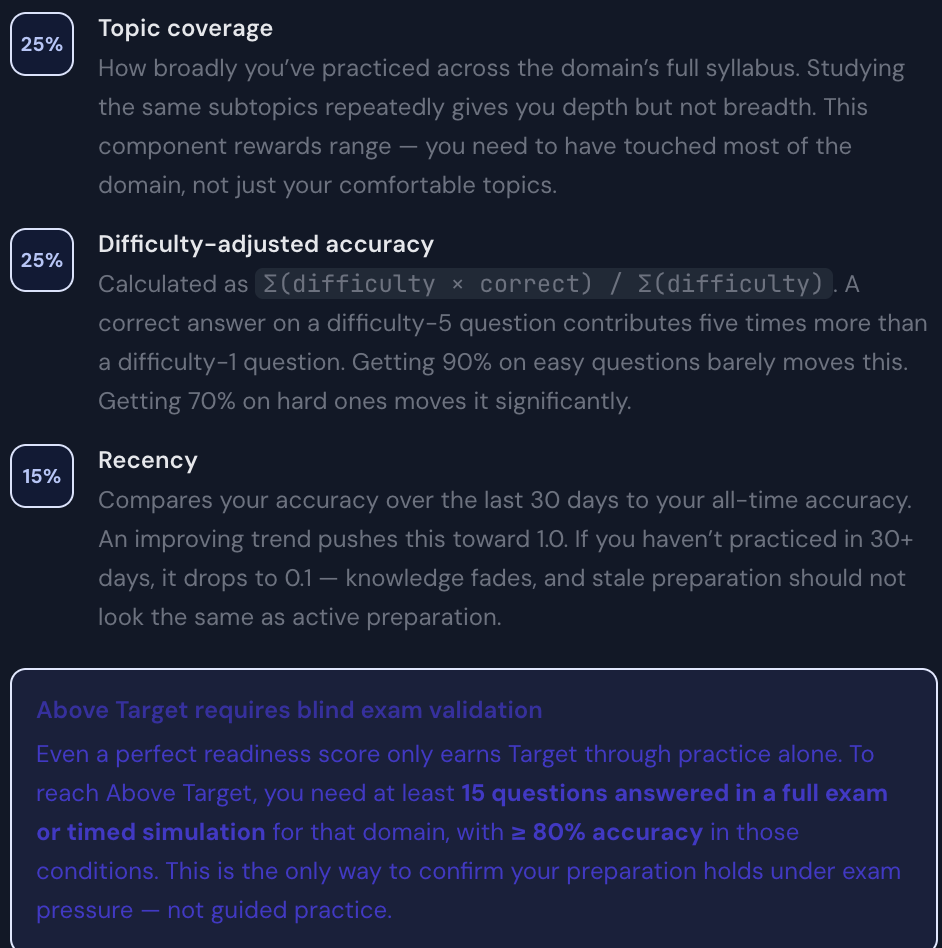
Compares your accuracy over the last 30 days to your all-time accuracy. An improving trend pushes this toward 1.0. If you haven't practiced in 30+ days, it drops to 0.1.
Knowledge fades. Stale preparation shouldn't look the same as active preparation. This component reflects whether your readiness is current — not just accumulated.
Above Target Requires Blind Exam Validation
Here's the rule that surprises most people: you cannot reach Above Target through guided practice alone.
Even a perfect readiness score only earns Target through practice sessions. To reach Above Target for a domain, you need:
- At least 15 questions answered in a full exam or timed simulation for that domain
- ≥ 80% accuracy in those conditions
This is by design. Guided practice gives you unlimited time, no pressure, and immediate feedback. Exam conditions don't. Above Target is reserved for performance that holds up outside of guided practice — confirmed by actual timed simulation data.
The "Path to Exam Ready" section shows exactly what's needed to advance each domain from Target to Above Target. Once you've completed a full timed exam, that blind performance data unlocks the rating.
What to Do With This Information
If you're at Approaching Ready, your next move is clear: take a full timed practice exam. Not more guided practice — a simulation. The readiness score can't tell you whether your knowledge holds under time pressure until you've actually tested it that way.
If you're at Developing or below, look at the domain breakdown. Where is your readiness score lowest? Where is coverage thinnest? Those are the areas to drill — not your strongest domains.
The readiness score isn't a grade. It's a diagnostic. Use it to direct your effort toward what actually needs work, and stop spending time on areas where you've already cleared the bar.